Duct Repair & Sealing Through the Tucson Year
Fall is the assessment and planning window. The brutal season is past, the equipment has just told you exactly what condition it is in by how it survived, and there is time to repair what limped, replace what failed on paper, and plan the work before next June writes the exam again. It is also when honest HVAC advice happens, because a system inspected in October is being judged on evidence, not on hope.
Summer splits in two: the dry furnace of June and early July, when the heat is at its peak and systems run from mid-morning to past midnight, and the monsoon weeks that follow, when humidity joins the heat and the failure mode changes. Most breakdowns are discovered in summer - the wear happened across a decade of summers, and the hottest week is simply when the margin runs out. Shade, airflow and a clean coil are the season's quiet essentials.
Spring is the preparation season in Tucson, and everyone who has lived through a June here knows it. March through May is when systems get their honest read: refrigerant charge, airflow, duct condition, cooler pads and pumps - while the weather is still mild enough that a discovered problem is an appointment, not an emergency. The first 100-degree day usually arrives before May is out, and it collects every debt the spring skipped.
Duct Repair & Sealing in Depth
Duct repair is applied honesty: the system has been making a certain amount of cold air all along, and the ducts have been deciding how much of it the house ever sees. The measurement that opens the job - how much air leaves the unit, how much arrives at the registers - is the whole story in two numbers, and the repair is the work of closing the distance between them.
It is also the job whose value compounds quietly. Sealed ducts do not just cool better this summer; they reduce every future summer's runtime, dust load and equipment wear, and they make the next equipment replacement smaller and cheaper than the last. Of all the work in the trade, duct sealing is the one whose benefits are still arriving, unbilled, a decade later - the closest thing HVAC has to a permanent improvement.
Choosing the Right Help
Choosing duct help means choosing measurement over opinion. Ask how leakage will be established - inspection plus airflow and pressure numbers - and how the result will be verified afterward. The service that offers before-and-after figures is selling a result; the one that offers to 'seal everything up' without numbers is selling an activity, and activities do not cool rooms.
The Climate Behind It
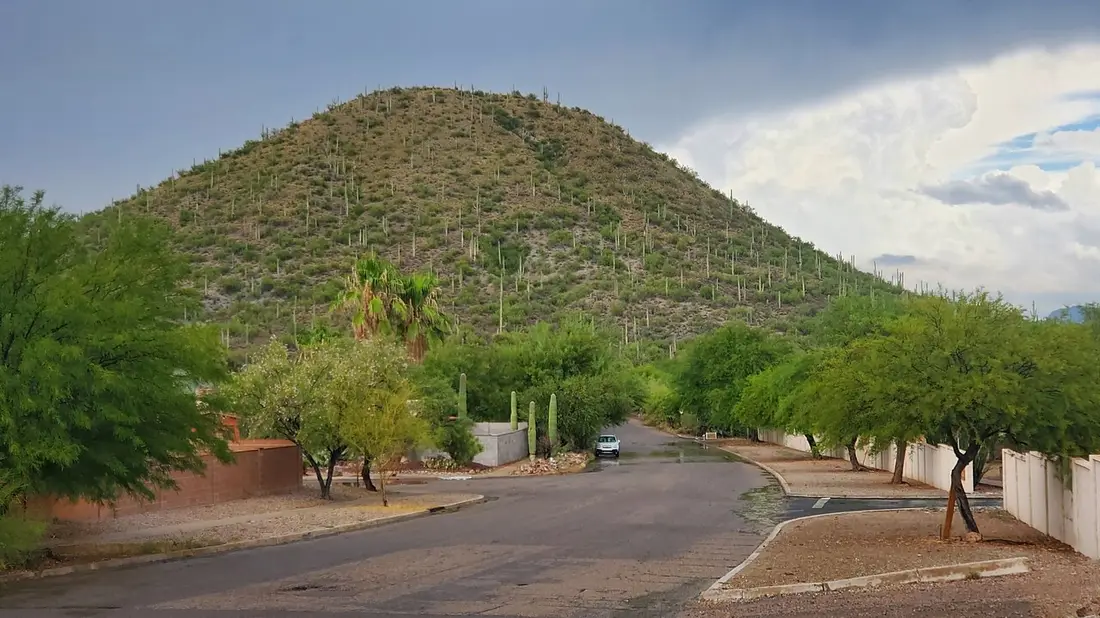
Tucson sits in the Sonoran Desert at the meeting of five mountain ranges, and the desert writes the cooling calendar here: a long, fierce summer in which June afternoons pass 110 degrees, a monsoon season that trades dry heat for humid heat overnight, and winters mild enough that heating is a supporting act. An air conditioner in Tucson is not a comfort appliance - for a large part of the year it is the system the house cannot be lived in without.
Heat load is the signature force. A Tucson roof in June absorbs sun from before nine until after six, attic temperatures climb far past anything the equipment below was tested at, and west-facing glass turns rooms into solar ovens by late afternoon. A system's real rating in this city is not its nameplate - it is what it still delivers at four in the afternoon in the third week of June, after a decade of desert summers.
How Duct Repair & Sealing Works
Inspect the whole air path
Every accessible run, joint, boot and return is examined - in the attic, the crawl space or the chase - and the leaks are found by looking and measuring, not by guessing from the thermostat.
Measure before and after
Airflow at the registers and the system's static pressure are recorded first, so the repair's effect is a number, not an impression.
Repair, seal and support
Failed runs are replaced, joints are sealed with mastic and fastened mechanically, sagging flex is supported to its proper slope, and boots are reattached and sealed.
Balance and verify
Dampers and registers are set room by room, pressures re-measured, and the hot room's verdict collected last - it is the report card of the whole job.
Doing It Yourself vs a Professional
The DIY Route
- Wrapping a separated joint in ordinary duct tape - which is, famously, the one tape that fails in hot attics within a season or two
- Closing off 'unused' rooms' registers to save money, which raises duct pressure and increases leakage everywhere else
- Adding a booster fan to a starved run instead of fixing the kink or leak that is starving it
VS
The Professional Route
- Finds the fault by inspection and measurement - pressures and register airflow, not hunches
- Seals with mastic and mechanical fasteners rated for attic heat, and supports runs to proper slope
- Balances the finished system room by room and leaves before-and-after numbers
Keep It From Coming Back
Duct systems fail slowly and announce quietly. These habits catch the announcements while the repair is still small, sealed and scheduled.
- Have ducts inspected whenever equipment is replaced - new machines deserve an honest air path, and the verdict costs least then.
- Keep attic access clear and the attic itself visited occasionally; a separated boot found in May is a repair, found in August is a season of bills.
- Seal the attic hatch and can lights where they leak house air upward - the duct system is not the only hole in the ceiling.
- After any attic work by any trade, ask whether the ducts were disturbed; more duct damage is done by other people's boots than by time.
- Note the rooms' temperatures season to season; a room drifting warmer is the duct system's earliest press release.